
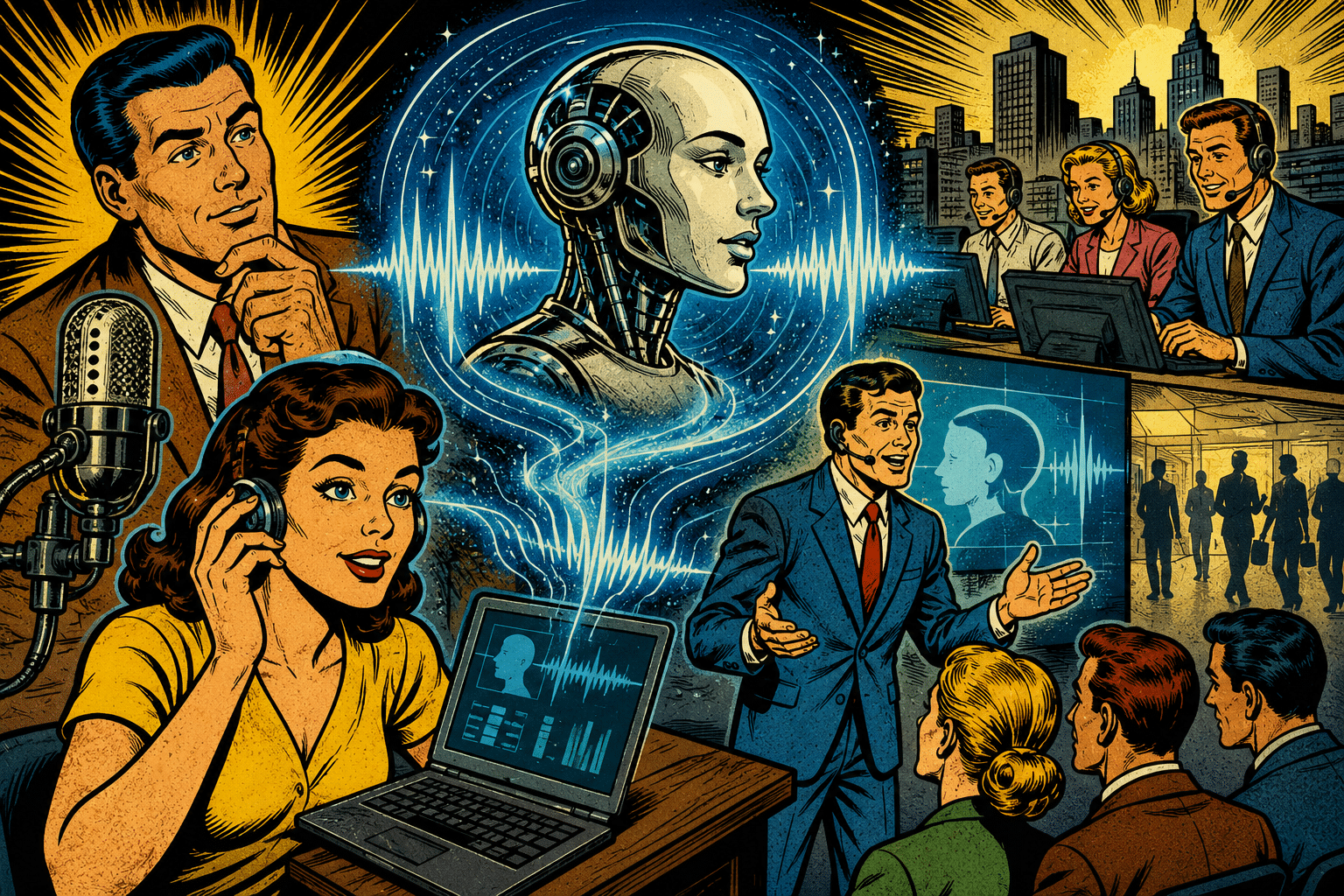
Have you ever heard of ElevenLabs? If not, it’s time to catch up.
Founded by two Polish engineers, this American company is reshaping the tech industry. Backed by major players such as Nvidia and BlackRock, and supported by Hollywood figures including Eva Longoria, Matthew McConaughey, and Jamie Foxx, the company has experienced remarkable growth. Today, ElevenLabs is widely regarded as the global benchmark in speech synthesis, offering more than a thousand synthetic voices and state-of-the-art contextual and prosodic analysis.
While the entertainment industry (content creators, audiobook publishers, media companies) is closely watching this revolution, technical support and call center operations are likely to experience the most profound disruption. The deployment of ultra-realistic voice agents promises massive productivity gains for organizations while fundamentally redefining the customer service job market.
Yet beyond the economic implications lies a far more fascinating phenomenon—one that many voice professionals still underestimate.
A fundamental question is emerging:
Who is training whom?
From the oro-phonatory loop to the digital loop
Human speech develops through what is known as the oro-phonatory loop: we hear, imitate, adjust, and refine.
To build its models, AI has done essentially the same thing. It has absorbed vast quantities of human voices, capturing timbre, texture, rhythm, and prosody. In a sense, ElevenLabs has industrialized this learning process by creating a digital oro-phonatory loop capable of generating countless unique vocal identities.
But a paradigm shift is coming—one that very few people see.
Once synthetic voices become fully integrated into our daily acoustic environment and consistently satisfy listeners, the reference point will begin to reverse.
Instead of machines imitating humans, humans may start unconsciously using machines as the benchmark for what a “good” voice sounds like.
At that point, ElevenLabs—and similar companies—would no longer simply generate voices.
They would define the standard.
The ideal pacing of pauses.
The preferred melodic contours.
The optimal clarity of articulation.
Across languages and cultures.
AI as an amplifier of vocal coaching—not a replacement
Should voice professionals fear this evolution?
Quite the opposite.
Just as large language models such as ChatGPT or Claude augment rather than eliminate many forms of expertise, advanced voice AI has the potential to become an extraordinary accelerator for vocal coaching.
For a vocal coach, these tools make it possible to generate highly personalized prosodic models tailored to specific objectives:
- Conferences
- Negotiations
- Fundraising pitches
- Leadership communication
AI can instantly model the acoustic target.
What it cannot do is teach a person how to embody it.
Why?
Because ElevenLabs does not understand vocal physiology.
Algorithms know nothing about:
- The mechanisms of voice production
- Physical grounding
- The bodily organization required to project authority in a real space
That is precisely where human expertise remains irreplaceable.
AI can define the acoustic destination.
The coach provides the physiological and neurological roadmap required to reach it efficiently, sustainably, and without tension.
Technology is not a threat to vocal leadership.
It may well become its most powerful accelerator.
That is why I have decided to embrace this transformation and leverage the opportunities offered by AI to support my clients as closely as possible to their real-world needs.
