
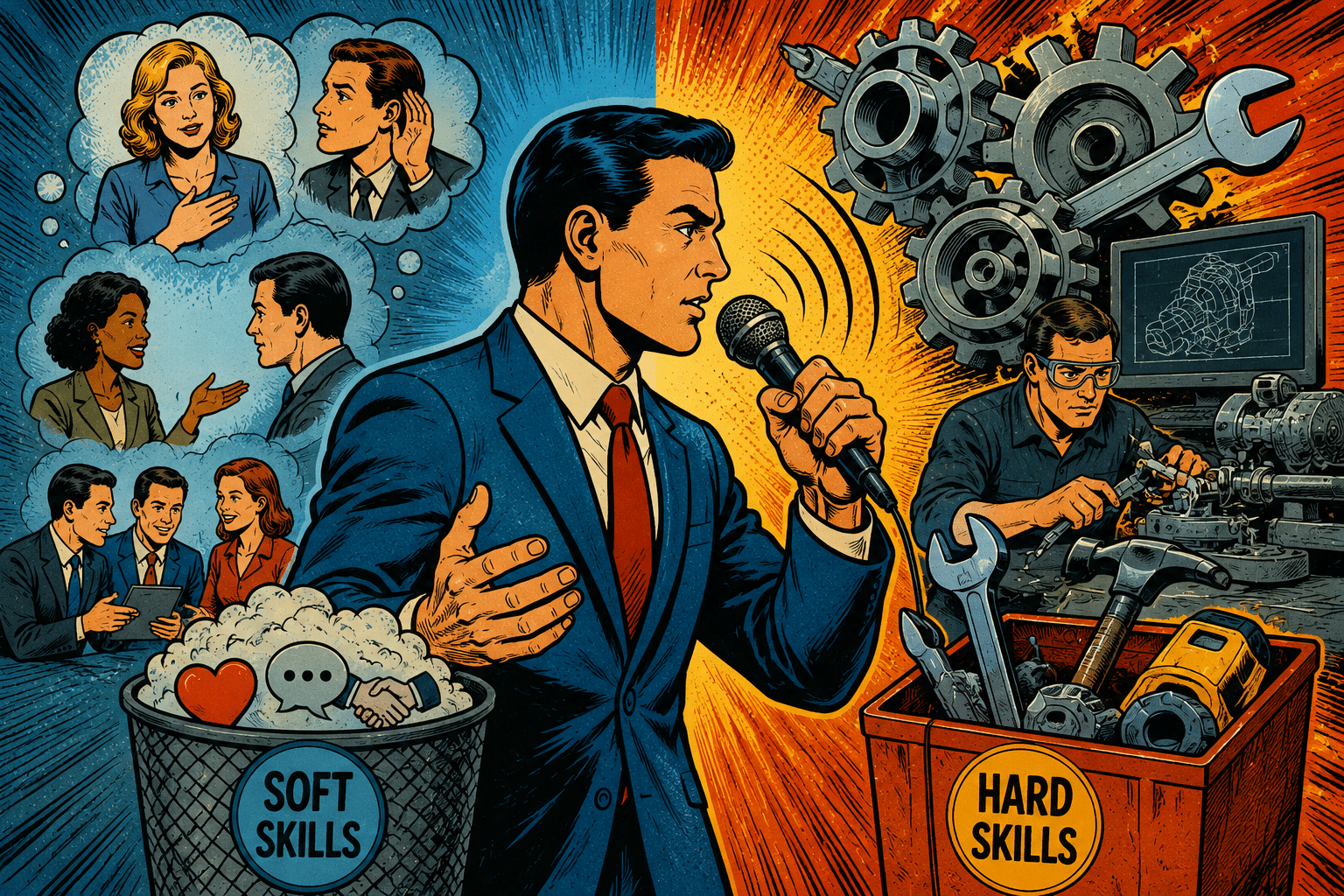
In the professional world, we have a long-standing habit of compartmentalization. We categorize “Hard Skills” as technical proficiencies: accounting, plumbing, coding, or engineering. They are tangible, measurable, and often require years of disciplined practice. Then, there are “Soft Skills”, the interpersonal traits like active listening, empathy, or team management.
Somewhere in this divide, we’ve filed “Public Speaking” and “Voice Control” under the “Soft” category. We treat them as innate talents or personality traits, something you either have or you don’t.
This is a fundamental mistake. If knowing how to play the piano or build a table is a “Hard Skill”, requiring specific mechanical control, physiological coordination, and mastery of a tool, then knowing how to operate your own vocal apparatus is, by definition, a Hard Skill. It is the mastery of a biological instrument with actual measurable markers that is your primary interface with the world.
Where voice becomes an undeniable hard skill
There are specific professions where vocal mastery is universally recognized as vital. In these fields, your voice is your capital; if the machine breaks, the business stops.
- Performers (Singers and Actors): They occupy the pinnacle of this requirement, needing both pristine acoustic quality and extreme physical resilience.
- Broadcasters and Presenters: For radio and TV, acoustic precision is the product itself.
- High-Volume Professionals (Teachers, Call Center Agents, Police Officers, Lawyers): These individuals face a “double bind”: they must maintain constant, high-quality output while managing a heavy “vocal load” that leads to rapid physical fatigue.
- Outdoor Professionals: Those working in challenging environments require specific vocal mechanics to be heard and understood over background noise without causing trauma to their larynx.
In these sectors, when the voice fails, the economic disruption is immediate. The individual loses their livelihood, and the society suffers the cost, whether it’s the disruption of public services, the strain on the healthcare system from vocal disorders, or the loss of productivity in essential infrastructure.
The invisible cost of vocal neglect
If the disruption is so obvious for a singer or a teacher, why do we treat the CEO, the founder, or the salesperson differently?
Consider Immigration Officers managing a diverse crowd. If their voice is strained, monotone, or physically exhausted, they aren’t just “unclear.” They are failing to project the authority, welcoming nature, and stability of their host country. A tired, poor-quality voice can be the difference between an immigrant feeling supported or alienated. That is not just a soft communication issue; that is a failure in the delivery of a public service.
Or consider a CEO presenting a new production process. If the voice is weak, uncertain, or monotonous, the message fails to land. The team feels uninspired, the process is misunderstood, and productivity stagnates. Conversely, an assertive, resonant, and nuanced delivery turns a technical update into an act of leadership. It motivates, clarifies, and aligns. That is a measurable increase in organizational productivity.
Why do we underestimate the voice?
So, why isn’t vocal mastery universally taught as a Hard Skill?
We tend to value tools we can touch, the software, the ledger, the lathe. Because our voice is always with us, we treat it as an extension of our personality, a “Soft” part of “who we are”, rather than a complex biological tool we can calibrate.
We assume that because we use our voices every day to talk to friends, we already possess the “hard skill” of speaking. But speaking casually with friends is to vocal mastery what walking to the fridge is to professional sprinting. Both involve using your legs, but the physiology and training required for peak performance are entirely different.
The Future: The Voice as Your Primary Asset
As we move deeper into an era of Voice AI and synthetic media, the value of human vocal mastery will not decrease: it will increase.
Even if you replace a human agent with a voicebot, you still need to ensure that the voice is flawlessly pleasant and prosodically precise to win over the audience. If you are the human behind the mic, your voice is your brand identity. It is the raw signal that bypasses logic and speaks directly to the limbic system of your listener.
Mastering the mechanics of your voice, projection, pressure management, and resonance, is no longer just about “being a good speaker.” It is about vocal ergonomics. It is the professional discipline of optimizing your primary communication tool to ensure longevity, authority, and maximum impact.
It is time to move the voice out of the “Soft Skill” bucket. Treat it like a tool, train it like an athlete, and optimize it like an engineer. Your career and your productivity depend on it.
