
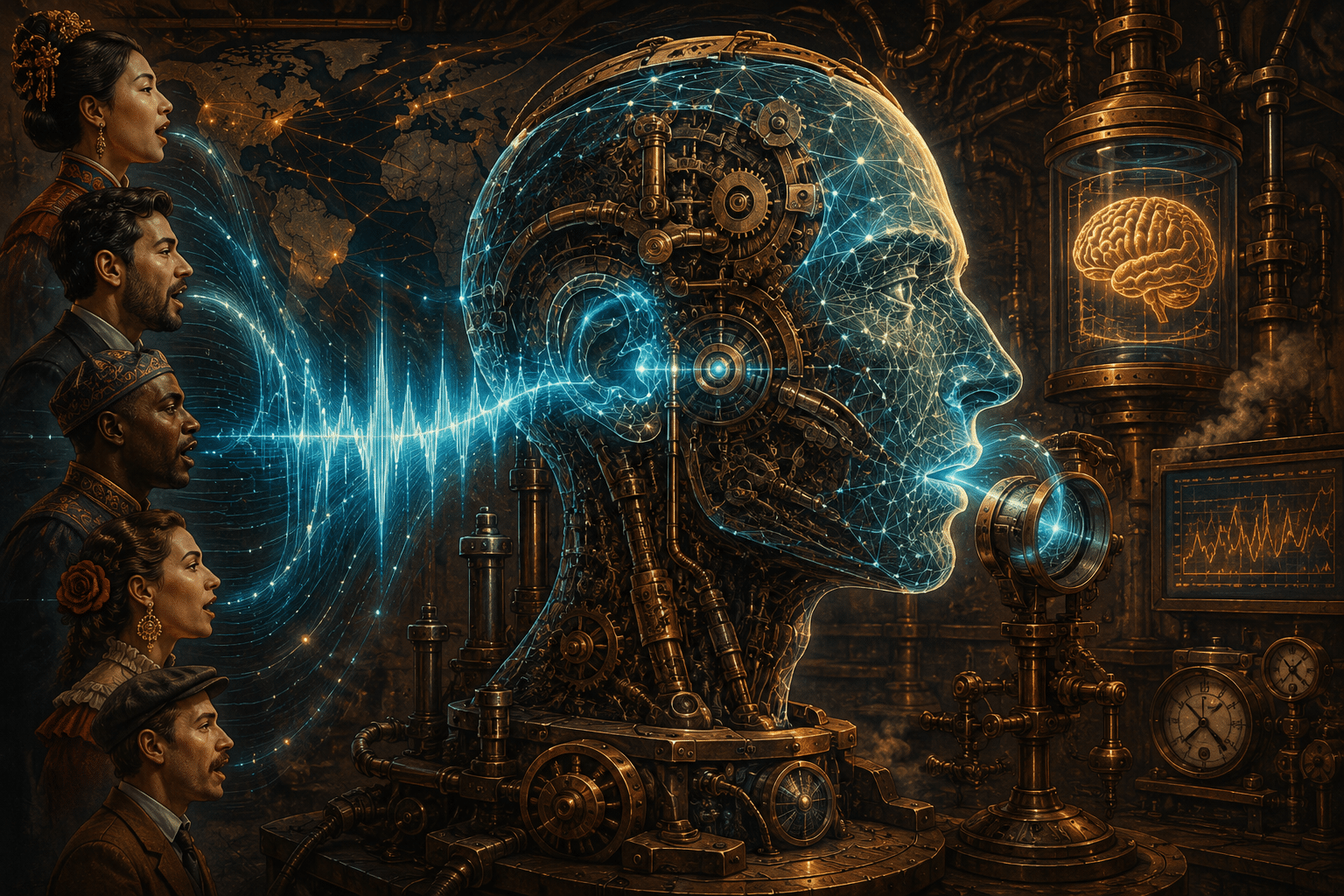
In the corporate world, we quantify everything: balance sheets, marketing ROI, and supply chain efficiency. Yet, one blind spot persists in our daily interactions: the human voice. Long relegated to a stylistic or cultural attribute—shaped by accent, dialect, or local social codes—the voice is undergoing a radical redefinition driven by cutting-edge technology.
We are currently witnessing the convergence of three rapidly expanding technological markets: vocal diagnostics via digital biomarkers, emotion recognition tied to social cognition, and the massive rise of Voice AI. What this technological wave reveals is as fascinating as it is unsettling: AI is not inventing the universality of our vocal signals. It is simply industrializing and objectifying a biological evaluation mechanism that the human brain has been performing unconsciously since the dawn of time.
The Industrialization of Voice and the Acoustic Data Gold Rush
The interest shown by tech giants and venture capital firms in the human voice is no longer anecdotal. Massive investments over recent years demonstrate that the voice is now treated as a major strategic interface and a source of unprecedented physiological data.
In early-stage pathology detection, companies like Canary Speech have raised over $22 million to develop algorithms capable of identifying cognitive decline, depression, and neurological disorders through continuous speech analysis. Similarly, Sonde Health has secured $35.25 million in funding focused on detecting physiological variations, respiratory load, and cognitive impairments.
In synthetic voice and conversational interfaces, the trend is equally spectacular. ElevenLabs has reached a multi-billion dollar valuation, while major AI labs are accelerating consolidation efforts. Notably, Anthropic raised a historic $30 billion according to Bloomberg data, placing the voice at the center of the AI language model war. In this race for talent and infrastructure, the sector saw the strategic acquisition of Weights.gg, a startup specializing in voice cloning technology, as reported by The New York Times. This financial fervor proves that the voice is no longer just a vessel for thought, but a highly predictive asset.
Algorithmic Models vs. The Universality of Biology
A legitimate argument often raised against these technologies is data bias. It is true that the vast majority of datasets used to train these models are heavily skewed toward Western and English-speaking populations. Yet, despite this initial imbalance, researchers observe a surprising consistency: these models generalize their predictions remarkably well across different languages.
The reason for this cross-border success is purely neurophysiological. These algorithms do not stop at the words chosen; they analyze the deep structures of the acoustic signal:
- Stability and harmonic perturbations.
- Management of subglottic pressure and respiratory flow.
- Intrinsic tension of the laryngeal muscles.
- Speech rate and micro-instabilities in fundamental frequency.
Whether a speaker uses French, Japanese, or Portuguese, a glottal leak remains a glottal leak, a vocal tremor linked to a neurological condition maintains its mechanical signature, and respiratory fatigue affects pneumo-respiratory support in the same way. AI decodes these elements because it relies on biological constants shared by the entire human species.
Insights from Neuroscience: Cultural Filters vs. Biological Constants
To understand the duality between the biological and the cultural, one must look at the work of researcher Silke Paulmann. Her studies in communication psychology highlight the existence of an « intra-group advantage. » Culture undeniably influences how we package our communication: a native speaker will always decode the subtle nuances of irony, sarcasm, or cultural implicitness better than an outsider.
However, once we descend to primary emotions and baseline psychophysiological states, cultural barriers collapse. Anger, fear, exhaustion, calm, effort, dominance, and submission manifest through universal acoustic configurations.
This reveals an uncomfortable reality: our brains perform the same work as machines, but intuitively and pre-cognitively. Research by McAleer, available on ScienceDirect, demonstrates that humans need only a few hundred milliseconds to form a judgment of trustworthiness or authority based on a vocal stimulus. AI has invented nothing; it was trained on data annotated by humans, capturing universal recurrences encoded in our genetic heritage and evolutionary adaptation.
What This Means for the Professional World
For executives, entrepreneurs, and negotiators, mastering these mechanisms is critical. Developing vocal expertise is no longer an aesthetic preference—it is a requirement for operational performance and time efficiency.
In high-pressure situations—such as international fundraising, strategic negotiations, or managing global teams—every imperfection in your vocal instrument sends an immediate negative biological signal to your audience. A high-pitched voice, a pace rushed by stress, a lack of respiratory support, or a « tight » voice are immediately interpreted by your listeners’ limbic systems as indicators of anxiety, fatigue, or fragility. Rational arguments can lose all impact when undermined by this underlying biological message.
Conversely, a mastered vocal leadership is characterized by harmonic stability, anchored breathing, and acoustic clarity. These attributes send a universal signal of competence, assurance, and emotional control, capable of crossing linguistic barriers to build immediate trust and reduce the friction that slows down high-stakes decision-making.
Conclusion: The Voice is a Raw Signal, Language is Just the Outfit
For decades, the corporate world approached public speaking solely through the lens of presentation techniques, body language, or word choice. The rapid rise of Voice AI is reminding us of a more raw truth: the voice is, first and foremost, a transmitter of complex biological signals.
Language dresses our thoughts, and culture modulates our style, but the foundations of our vocal communication rest on our physiology. At a time when algorithms are capable of mapping our internal states at scale, tomorrow’s leaders must master their own sonic instrument to align their biological identity with their strategic ambitions.
