
Individual communication coaching : master your voice and impact
Our individual coaching is designed for those who want to transform their communication into a powerful tool for success. Whether you are preparing for a career shift or looking to enhance your daily presence, each coaching session is a step toward vocal and oratory mastery.
Inside a signature coaching session
Each coaching session is structured to provide immediate, tangible results through a proven technical approach :
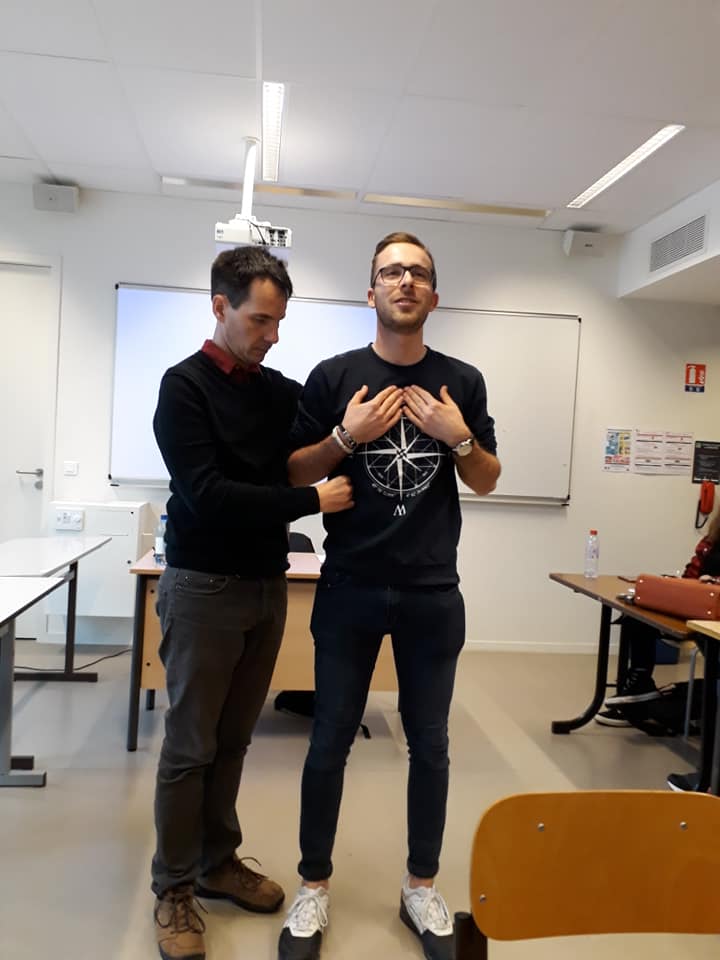
- Physical awareness : we begin with exercises to raise awareness of the body and the muscles involved in the phonatory system ;
- Breath mastery : you will practice inhalations that make the muscles engaged during inspiration and expiration perceptible to build a solid vocal foundation ;
- Vocal warm-ups : the session continues with exercises to place the voice on the breath and become familiar with different laryngeal mechanisms ;
- Anatomical exploration : we explore the interrelations of your anatomy and various resonance cavities to enrich your vocal texture.
Real-world applications for your career
We don’t just practice in a vacuum. Every coaching session adapts to the specific challenges of your professional landscape :
- Salary negotiations : learn to maintain a steady, persuasive tone when discussing your value ;
- Pitching to recruiters : project confidence and clarity to stand out in a competitive market ;
- Executive presentations : master presence and projection for high-stakes public speaking ;
- Workplace simulations : direct application of learned skills through common professional scenarios.
The path to oratory charisma
Our method focuses on developing deep awareness and eloquence through a structured loop :
- Targeted exercises : postural, respiratory, and vocal training ;
- Situational practice : immediate feedback on your pitch or presentation ;
- Instant analysis : recording and playback for constructive, data-driven feedback ;
- Integration : personalized take-home protocols to practice in real-life situations.
Start your transformation today
Ready to elevate your communication? Choose the format that fits your goals :
- The starter pack : a specialized bundle designed to identify your potential and establish your vocal foundations ;
- Single coaching session : targeted support for an upcoming event or a specific vocal challenge ;
- Custom follow-up : optional sessions tailored to your evolving needs and long-term growth.
Book your first coaching session now and experience the difference of expert guidance.
Flexible formats for personalized growth
- Versatile delivery : each coaching session can be conducted in-person or remotely to suit your schedule and location ;
- The remote advantage : effectiveness remains consistent in remote sessions, with the specific advantage of immediate webcam feedback. this allows for increased awareness of the image projected to your peers, worked on collaboratively in real time ;
- Fully personalized content : for those seeking a unique experience, every coaching session is adapted with specific content to meet your individual professional challenges ;
- Transparent planning : to ensure clear expectations, the recommended number of sessions for each specific need is indicated at the very outset of your journey.
Vocal and communication goals : session recommendations
Number of sessions | ||
|---|---|---|
| Diction and articulation | Correction of consonant and vowel pronunciation to enhance voice projection | 6 sessions |
| Speech rate mastery | Techniques to stabilize a speech rate that is consistently too fast or too slow | 5 sessions |
| Vocal power and projection | Strengthening an inaudible or weak voice (asthenia) for better impact | 4 sessions |
| Resonance and Rhinolalia (nasal voice) | Adjusting the melodic contour to correct a somewhat nasal voice | 6 sessions |
| Stress and breath management | Preventing vocal fatigue and shortness of breath caused by rising stress | 4 sessions |
| Vocal health and stamina | Protocols to avoid roughness, hoarseness, and any form of vocal fatigue | 7 sessions |
| Presence in meetings | Learning to be heard and respected, specifically for introverted or shy profiles | 3 sessions |
| High-stakes presentations | Fully embodying high-quality content to deliver a successful presentation | 4 sessions |
| Vocal pathologies support | Specialized coaching for voice recovery or functional disorders, often in coordination with medical experts | To be determined upon assessment |
| Speaker and leadership training | Foundational training to become a professional speaker or run for office | 12 sessions |
Expert guidance adapted to your location : join us via video call
✓ Awareness of the impact of your voice
✓ Evaluation of physiological state
✓ Instant snapshot of vocal and emotional impact
✓ Identification of areas for improvement
✓ Improvement of communication
The strategic impact of personalized communication coaching
Beyond technical mastery, an individual coaching session serves as a powerful catalyst for professional growth and leadership.
By aligning your vocal identity with your strategic objectives, you develop an authentic presence that commands respect in every interaction.
The benefits extend far beyond public speaking : you will gain greater emotional regulation under pressure, a refined ability to structure persuasive arguments on the fly, and a noticeable increase in your natural charisma.
This holistic approach ensures that your communication is not just heard, but remembered.
Each coaching session is designed to bridge the gap between your expertise and your impact, turning your voice into a reliable asset for salary negotiations, high-stakes board meetings, or career-defining presentations. Ultimately, the goal is to provide you with a sustainable toolkit of skills that allow you to project confidence and authority in any context, ensuring your message always hits its mark with precision and poise.
