
Vocal fatigue is not a fatality, it is a signal. If your voice becomes exhausted, hoarse, or painful, you are forcing your instrument. Whether you are coming out of a speech therapy pathway or seeking to optimize your vocal comfort, discover how vocal coaching makes it possible to durably release vocal tensions.
Vocal fatigue, known under the medical term phonasthenia, is the first stage of vocal health degradation. It results from an imbalance in vocal production: the effort provided exceeds the resistance capacity of the vocal folds. If this vicious cycle of forcing is not broken, the functional disorder may evolve into acquired organic lesions such as nodules or polyps.
Why does vocal fatigue set in?
The mechanism of vocal fatigue is often linked to an accumulation of poor habits. When we are tired or under the influence of stress, we tend to contract the muscles of the neck, shoulders, and jaw in order to “compensate.”
This muscular forcing prevents the free vibration of the vocal fold mucosa. The result? The voice becomes dull, the timbre loses richness, and vocal tension becomes increasingly present. Stress acts here as a catalyst: it locks breathing patterns and fixes the larynx in a high position, thereby accentuating vocal exhaustion.
The contribution of the Vocal Coach: beyond speech therapy
Many people consult a vocal coach after having completed their speech therapy sessions, because they feel that a step is missing in order to regain full freedom in their professional or artistic life. Important: I am not a speech therapist. My approach is pedagogical and functional, not medical.
What vocal coaching specifically brings
If the speech therapist treats the “mechanics” and rehabilitates the pathology, the vocal coach supports you in how to use your voice in real-life situations:
- Transfer under stress conditions: How can you maintain a free voice during a high-stakes meeting or on stage, where old tension reflexes tend to resurface immediately?
- Performance optimization: Beyond care, the work focuses on timbre, resonance, and power. The goal is no longer simply to “stop hurting,” but to rediscover the pleasure of speaking.
- Work on extralaryngeal musculature: The coach pays particular attention to the tongue, the floor of the mouth, and overall posture—key areas that directly influence vocal fatigue.
- Vocal aesthetics: We work on your sound identity so that your voice becomes a tool of charisma, while remaining physiologically healthy.
Preventing organic lessions through improved vocal production
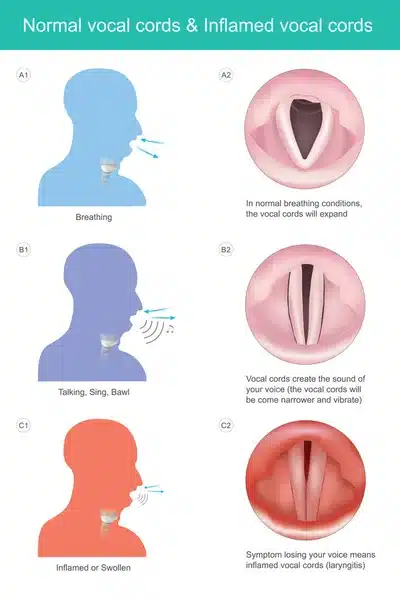
Ignoring chronic vocal fatigue means taking the risk of physically traumatizing your vocal folds. Repeated forcing creates inflammation which, over time, can develop into a lesion. The goal of coaching is to change your body language so that vocal production becomes a gesture of openness rather than closure.

5 best practices to relieve vocal fatigue
- Body grounding: Speaking starts from the feet. A stable posture frees the rib cage.
- Straw phonation (Lax Vox): This subglottic pressure exercise is a favorite tool among vocal coaches to “massage” the vocal folds after effort.
- Jaw release: Learning to speak with a supple jaw instantly reduces vocal tension.
- Hydration and sleep: The voice is living tissue. Without water and rest, recovery is impossible.
- Resonator management: Learning to vibrate the facial bones rather than the neck muscles in order to project the voice.
Note: In case of persistent voice loss, always consult an ENT physician. To better understand laryngeal anatomy, you can consult public health resources such as Ameli (French National Health Insurance).
