
Sulcus vocalis or vocal fold scarring: Although these alterations of the vocal fold structure are permanent, a functional and comfortable voice remains possible. The goal is not systematic surgical healing, but intelligent management to eliminate strain and restore the pleasure of communication.
Sulcus vocalis is an invagination of the mucosa along the free edge of the vocal fold. To simplify, imagine a small “groove” or a scar that adheres the mucosa to the underlying ligament. This anatomical peculiarity disrupts the natural vibration required for healthy vocal production.
A vocal fold scar is not inevitable. Discover how my technical approach to sulcus vocalis enables the recovery of a stable voice.
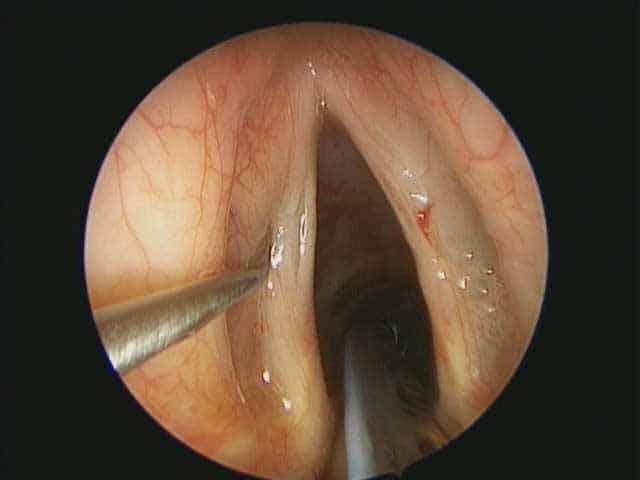
The sensory rehabilitation of sulcus vocalis
Sulcus vocalis creates a mucosal invagination that disrupts the natural mucosal wave. Unlike a nodule, a sulcus cannot be “removed,” but laryngeal mechanics around it can be optimized.
My work focuses on three technical axes:
- Glottic closure: Develop more efficient closure to compensate for air leakage (breathiness in the voice).
- Contact quotient management: Use water resistance exercises (straw phonation) to strengthen the vocalis muscle.
- Mucosal flexibility: Work on harmonics to mask the breathy timbre caused by the scar.
The three stages of sulcus vocalis
The pathology manifests in different forms, classified according to the depth of the lesion and the impact on the mucosal wave:
1. Physiological sulcus (Type I)
This is a simple superficial depression. The mucosal wave is generally preserved. Many individuals live with a physiological sulcus without ever experiencing discomfort, except in cases of intense fatigue or vocal overuse.
2. Stria-type sulcus (Type II)
Here, the depression is deeper and involves the ligament. The vocal fold loses flexibility. The voice becomes breathy, less powerful, and requires constant effort to produce.
3. Pathological sulcus or “open cyst” (Type III)
This is the most severe form, sometimes resembling a pouch or a cyst that has opened. The adhesion is deep, creating significant rigidity. Glottic closure is incomplete, generating a large air leak.
Impact on the voice and compensatory mechanisms
The main problem of the sulcus is not only the fissure itself, but the body’s reaction to compensate for the lack of vibration. Since the vocal folds no longer vibrate properly, the brain sends the command to “tighten” more forcefully.
- Muscle tension dysphonia: Appearance of tension in the neck, jaw, and shoulders.
- Compensatory spasms: The larynx stiffens in an attempt to force glottic closure.
- Chronic vocal fatigue: The energetic cost of speaking becomes exhausting.
Diagnosis: An essential medical step
Caution: The diagnosis of a sulcus vocalis or a vocal fold scar is strictly medical. Only an ENT physician or phoniatrist can confirm the presence of a sulcus through laryngoscopy or stroboscopy.
Within the scope of my functional coaching, the assessment I provide can identify acoustic indicators (frequency instability, breath noise, perturbation of the perceived mucosal wave). If these indicators suggest a structural anomaly, I will systematically refer you for a thorough medical examination to determine the exact nature of the issue.
Contribution of Vocal Coaching: Managing Rather than Curing
If the sulcus is not “curable” in the sense that the scar will not disappear, it is fully manageable. Vocal coaching is particularly effective for physiological types (Type I) and early striae (Type II).
Eliminating harmful compensations
The first step of my work consists of “unraveling” the muscle tension dysphonia. By releasing the peripheral muscles, the vocal fold can vibrate with the limited pliability it retains, without being paralyzed by excessive tightening.
Optimizing glottic closure
Once the tensions are released, we train the voice to achieve better adduction (closure). Using specific subglottic pressure exercises, we bring the vocal folds to meet more effectively, thereby reducing air leakage and improving the timbre.
Conclusion: Towards a More Functional Voice
Living with a sulcus vocalis requires patience and appropriate technique. The goal of coaching is to transform a “suffered” and fatiguing voice into a “managed” and efficient voice.
Need an assessment of your voice?
Do you experience persistent breathiness or fatigue that you cannot explain?
Note: This assessment allows us to guide your work and identify acoustic disturbances before any potential medical consultation.
