
Parkinson’s disease must not reduce you to silence. If hypophonia (weak voice) is a frequent symptom of the extrapyramidal syndrome, concrete solutions exist. Discover how support from a vocal coach makes it possible to go beyond the limits of classical rehabilitation in order to regain real impact in daily communication.
Parkinson’s disease is a complex pathology that affects global motor control, but its impact on the voice is often one of the most difficult aspects to live with socially. This disorder, linked to an extrapyramidal syndrome, alters the control of laryngeal and respiratory muscles, leading to what specialists call parkinsonian dysarthria.
Hypophonia: when the voice fades
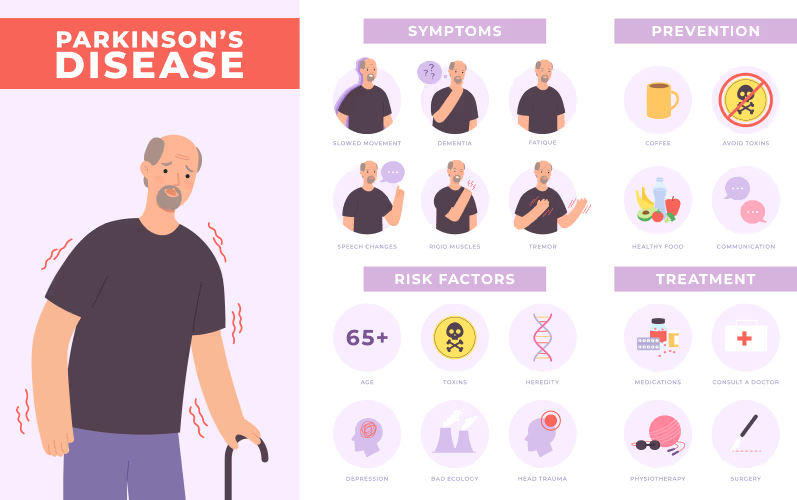
The major symptom of Parkinson’s disease at the vocal level is hypophonia. It is a significant reduction in sound volume. The main problem lies in perception: the affected person feels that they are speaking at a normal volume, whereas those around them perceive only a whisper or muffled voice.
This decrease in intensity is often accompanied by monotony of timbre and acceleration of speech rate. Without targeted intervention, this lack of power inevitably leads to social isolation, the patient giving up speaking for fear of not being heard.
Dyskinesias and extrapyramidal syndrome: motor impact
Extrapyramidal syndrome causes rigidity and bradykinesia (slowness of movement) that immobilize the thoracic cage and the larynx. Vocal production then becomes an effort at every moment.
Furthermore, the frequent occurrence of dyskinesias must be noted. Often iatrogenic in origin (related to long-term medical treatment), these involuntary movements can disrupt breath stability. A vocal coach helps navigate these fluctuations to maintain a stable voice despite the interfering movements.
Why choose a vocal coach as a complement to speech therapy?
It is essential to clarify that vocal coaching does not replace speech therapy, which remains the cornerstone of medical care. However, the approach of a vocal coach provides a different and essential dimension for guaranteed long-term results.
From medical care to social performance
The speech therapist rehabilitates vocal function. The vocal coach works on behavioral integration. The major difference lies in real-life transfer:
- Range of motion: Drawing on concepts such as the LSVT BIG method, the coach encourages the patient to “think big” so that the voice projects with force.
- Real-time biofeedback: Unlike exercises done alone at home after reading instructions online, the coach corrects posture and intention instantly.
- Management of intention: We work on the psychological aspect of projection to break mental blocks related to volume perception.
Rehabilitation vs. Training: the perfect synergy
If the speech therapist is the “physiotherapist” of the voice (treating the pathology and rehabilitating the gesture), the expert vocal coach is the physical trainer.
Working with a vocal coach as a complement allows you to:
- Move beyond the clinical framework: Apply rehabilitation gains in real situations (speaking, singing, performance).
- Maximize endurance: Go beyond mere recovery to develop an athletic and resilient voice.
- Save time: By combining therapeutic and technical approaches, you accelerate stabilization of the new vocal gesture.
The limits of online advice versus expert guidance
There are numerous free exercises available online for Parkinson’s disease and the voice. While these resources are useful for information, they carry a risk: performing movements incorrectly and generating compensatory muscular tensions (neck pain, jaw clenching).
Personalized guidance from an expert vocal coach is the only guarantee of a healthy gesture. I do not merely tell you to “speak louder”; we construct together a strategy so that this effort becomes a new automatic pattern without additional fatigue.
Core aspects of coaching for a Parkinsonian voice
- Verticality and grounding: Upright posture to free the diaphragm and provide a solid base for projection.
- Resonator amplification: Use of facial bony cavities to project sound without straining the vocal folds.
- Exaggerated articulation: Transform each syllable into a precise motor gesture to compensate for the articulatory imprecision caused by the disease.
The 5 pillars of vocal training for Parkinson’s disease
To counteract the reduction in vocal amplitude associated with the disease, coaching is structured around 5 physiological work axes:
- Intentional effort: Relearning to “speak loudly” to recalibrate the sensory perception of effort.
- Diaphragmatic support: Maximizing subglottic pressure for stable projection.
- Posture and openness: Releasing upper body tension to facilitate airflow.
- Exaggerated articulation: Enhancing phonetic clarity for better intelligibility.
- Prosody: Working on voice melody to avoid monotony.
Neuroplasticity serving your voice
Expert vocal coaching relies on principles of neuroplasticity. By repeating targeted high-intensity exercises, we force the brain to create new motor patterns to compensate for deficient automatisms.
This sensory recalibration work is essential: it breaks the vicious circle in which the patient thinks they are speaking normally while their environment hears little. Using biofeedback tools and careful listening, we stabilize subglottic pressure so that vocal effort becomes a new, natural, and durable reflex.
The impact of vocal coaching on confidence and social life
Beyond pure technique, vocal coaching in the context of Parkinson’s disease addresses a fundamental issue: social reconnection. When the voice weakens (hypophonia), the risk of isolation increases because the person hesitates to speak in groups or on the phone.
My approach aims to restore communicative assurance. By working on the intentionality of the message, we do not only strengthen the laryngeal muscles, we give the speaker back the pleasure of being heard and understood. Recovering a voice that “carries” is, above all, regaining one’s place within family and professional surroundings, reducing frustration from incessant repetition.
Conclusion: Regain control over your communication
Parkinson’s disease reduces your vocal space, but it does not define your capacity to interact with others. By combining medical follow-up and intensive vocal coaching, you can reverse the trend of hypophonia.
My role as a vocal coach is to provide you with the tools so that your voice again reflects your personality: present, clear, and impactful.
Guaranteed results: Do not let your voice fade
This work on vocal power complements solutions proposed for vocal fatigue.
