
Succeed in communication with a cochlear implant through vocal coaching.
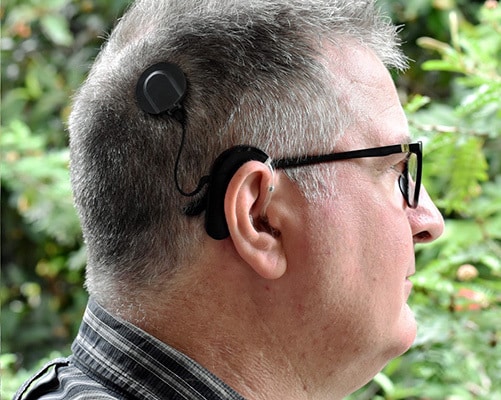
The cochlear implant allows the restoration of access to the sound world, but control of one’s own voice remains a major challenge. Between electronic perception and physical production, vocal coaching provides a space for refinement to regain a richer, better-timbered, and above all, less fatiguing voice.
Wearing a cochlear implant is a revolution for people with profound or severe deafness. However, it is essential to understand that the implant restores only part of the sound spectrum. This “synthetic” hearing profoundly alters what is called auditory feedback.
The challenges of the voice after cochlear implantation
Cochlear implantation marks the beginning of a new auditory journey. However, the perception of one’s own voice through the implant is often initially described as metallic or distorted. This sensory mismatch can lead to a loss of control over intensity (speaking too loudly or too softly) and over pitch (monotone voice).
My guidance focuses on the audio-phonatory loop. The goal is to relearn to place your voice not only through hearing but through vibratory sensation and proprioception. By working on laryngeal relaxation and diaphragmatic support, we stabilize the timbre so that it becomes natural again and less fatiguing to produce.
Understanding auditory feedback with a cochlear implant
Auditory feedback is the loop that allows your brain to hear your own voice in real time to adjust volume, pitch, and quality. With a cochlear implant, this loop is altered:
- Partial restitution: The implant prioritizes intelligibility (understanding words) rather than the harmonic richness of music or voice.
- Perception mismatch: The user does not always hear the subtleties of their own timbre, which can lead to a voice perceived as “monotone” or lacking timbre by others.
The role of the speech-language pathologist: the foundation of production
After cochlear implant placement, the work of the speech-language pathologist is essential and primary. Its objective is functional:
- Restore consonant production for intelligibility.
- Work on articulation and lip-reading.
- Ensure that basic communication is re-established, even if the voice remains imperfect.
However, in this effort to “be heard,” many users develop muscle tension dysphonia. By exaggerating effort to compensate for the lack of auditory feedback, tensions form in the neck and jaw, making the voice strained.
The contribution of the vocal coach: refinement and sensation
Where speech therapy stops at functional restoration, vocal coaching intervenes on the qualitative aspect. My role is to help “feel” the voice rather than hear it only through the implant.
Pallesthesia: the sense of vibration
Since auditory feedback is partial, we develop pallesthesia, that is, sensitivity to bone-conducted vibrations. If strong muscular tensions are present, these vibrations cannot be perceived. My coaching aims to:
- Release tensions to allow the resonators to vibrate freely.
- Learn to place the voice in the “mask” (facial bones) for a richer timbre.
- Use the body as a resonating chamber to stabilize volume without effort.
Correction of nasality and soft palate
A common characteristic in cochlear implant users is a sometimes nasal voice. This is often due to a “lazy” soft palate that does not elevate sufficiently to close the passage to the nose. Through exercises of toning and perception, we relearn to direct the airflow to achieve a more oral and less pinched voice.
Why Choose Personalized Vocal Coaching?
Coaching by a vocal coach allows going beyond simple technique:
- Guaranteed results on comfort: Less fatigue after a day of conversation.
- Self-esteem: Regain a voice that resembles you and of which you are proud.
- Timbre refinement: A more melodic and less monotone voice for your listeners
Frequently Asked Questions About Vocal Coaching and Cochlear Implants
Why work on your voice with a cochlear implant? The implant allows hearing, but breath control and pitch modulation require specific training. Vocal coaching enables regaining richer prosody (speech melody) and prevents vocal fatigue caused by compensatory efforts.
Does vocal coaching help to understand others better? Indirectly, yes. By improving your own vocal production and frequency awareness, you refine your ability to decode the nuances in other people’s speech. This is complementary work to speech therapy.
How long does it take to see results? Each journey is unique, but from the first sessions, resonance exercises allow better “feeling” of your voice in the body, which immediately reduces vocal insecurity.
Conclusion: a voice that reflects you
Wearing a cochlear implant does not mean giving up a beautiful voice. By complementing your rehabilitation with work on vibratory sensations and tension release, you can transform your way of communicating.
Optimize your vocal comfort with your implant
Do you feel like you have to force your voice to speak? Let’s develop your vibratory awareness together.
For more information on advances in auditory rehabilitation, you can consult the resources of the National Federation of the Deaf in France or clinical studies on cochlear implantation.
